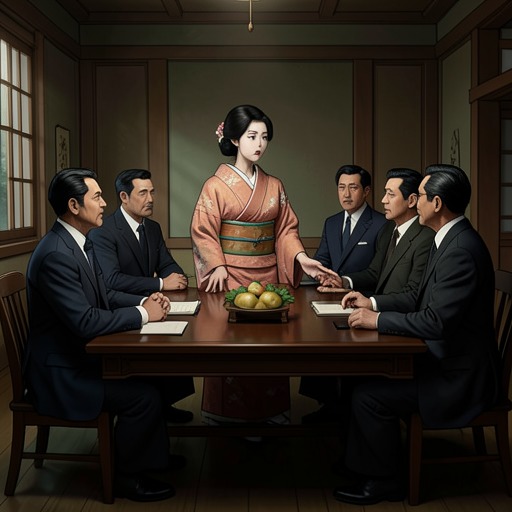
August 1945
Memoirs of a GeishaAugust 1945 is the turning point at which the war ends for Sayuri, but relief does not follow. Japan’s defeat brings a new period of fear and deprivation, even as survival gradually becomes imaginable; the date stands between the wartime systems that sustained the Nitta okiya and the postwar uncertainties confronting Sayuri and Iwamura Electric.
Wartime privilege and its collapse
Earlier in the war, the Nitta okiya occupied an unusually protected position. Because of General Tottori, it continued receiving food, tea, linens, cosmetics, and even chocolate after rationing began. Its relative abundance also made it a refuge for other okiya: in 1941, a maid caught with far more ration coupons than her household was allowed was sent there for safekeeping before being taken to the countryside. Tottori had instructed the military police to leave the household alone, placing it, in Sayuri’s image, in the warmest water of Gion’s pond.
That protection ended before August 1945. In December 1942 a military policeman confronted the household over wartime violations, including hoarding cotton, withholding metal and rubber, and misusing ration tickets. Sayuri understood that the okiya had survived longer and in better condition than most, and that its good fortune had made it a target. After Tottori’s misfortune, food and other supplies were taken away; ceramics and scrolls were confiscated and sold, partly as punishment. By mid-1943, the geisha community feared that the waves of war would overwhelm them, while rumors that the government would close the geisha districts grew credible.
The closure was announced during falling snow. Geisha were ordered to report to a registry office the next morning, and Sayuri immediately set out to find Tottori, her former danna, hoping to reach him before the other women did. The episode shows how wartime protection had narrowed into a desperate personal recourse: the political order that had sheltered the okiya was now dismantling its livelihood.
The end of the war and its aftermath
Sayuri dates the end of the war for her community to August 1945 and describes it not as a clean release but as the bleakest point in a long darkness. Defeat feels like being led, bound, to an execution ground; the country, in her account, has been destroyed, not merely defeated. For a year or more she hears no laughter, except from a small child whose grandfather silences him. The absence of laughter becomes a measure of the damage carried into childhood and ordinary life.
By spring 1946, the immediate ordeal of defeat seemed survivable. Stories that American soldiers would rape and kill the population had proved false, and people gradually recognized that the soldiers were, on the whole, remarkably kind. Sayuri watches their trucks pass in torn work trousers, unwashed for several days because fuel is too scarce to heat bathwater more than a few times a week. The contrast with her former life in Gion registers a profound change in status and circumstance, while the scene also marks her dawning awareness of how little she had considered the lives of other women.
Memory, loss, and postwar uncertainty
The war’s consequences reach beyond material deprivation. At Hakone, a train platform outside Kyoto brings back the earlier journey on which Sayuri and Satsu were taken from home. The remembered departure makes the wartime present open onto the losses of childhood: Satsu, their parents, and the house on the sea cliffs. Sayuri recognizes how thoroughly she had treated Gion as the whole world, and how grief returns without invitation, like a window opening of its own accord.
Postwar hardship also becomes visible in the damaged remains of Iwamura Electric. Nobu gives Sayuri a piece of concrete from the company’s Osaka factory, explaining that two of its four factories were destroyed and that the company might not survive the next few years. The fragment turns industrial ruin into a personal keepsake and links the recovery of a business to the persistence of its human relationships.
That vulnerability continues under the Allied Occupation. The authorities are prepared to make a final judgment against Iwamura Electric and seize the company; the Chairman and Nobu might have been barred from business altogether. The Minister intervenes, reopens the case, and persuades the authorities that the company had been treated too harshly. Thus August 1945 is not simply a boundary between war and peace: it begins a postwar struggle in which survival depends on new political circumstances and relationships, just as the old structures of protection have disappeared.
The date within a life of recollection
The narrative gives August 1945 public weight while keeping its meaning close to individual experience. Sayuri’s account moves between national defeat, the closing of the geisha districts, the precarious fate of a company, and objects that preserve personal histories. Years later, the Chairman says that remembered things can seem more real than what is presently seen. That reflection echoes the work performed by the date throughout the story: the past is not left behind at the end of the war but remains active in the lives and losses that follow.